
Mines strategy: what works and what only looks like it

Mines strategy exists, just not where people go looking for it. Tile order decides nothing, because the layout is locked before your first click. Two things decide the round: how many mines you set, and the multiplier you cash out on. Everything else marketed as a system either changes nothing or speeds up the losing. Both halves are worked through below, with the arithmetic attached.

The whole point in one paragraph

You cannot move the return. It is fixed by RTP and identical at every mine count. You can move the spread. The mine count sets the shape of a round, a cash-out point named in advance turns that shape into a decision, and picking a game by stated RTP is the only lever that shifts the expected result on its own: 98.4 against 92 is a gap of 6.4 points on every bet you place.

Why the order of tiles changes nothing

This is the first thing to accept and the only one that genuinely needs proving.

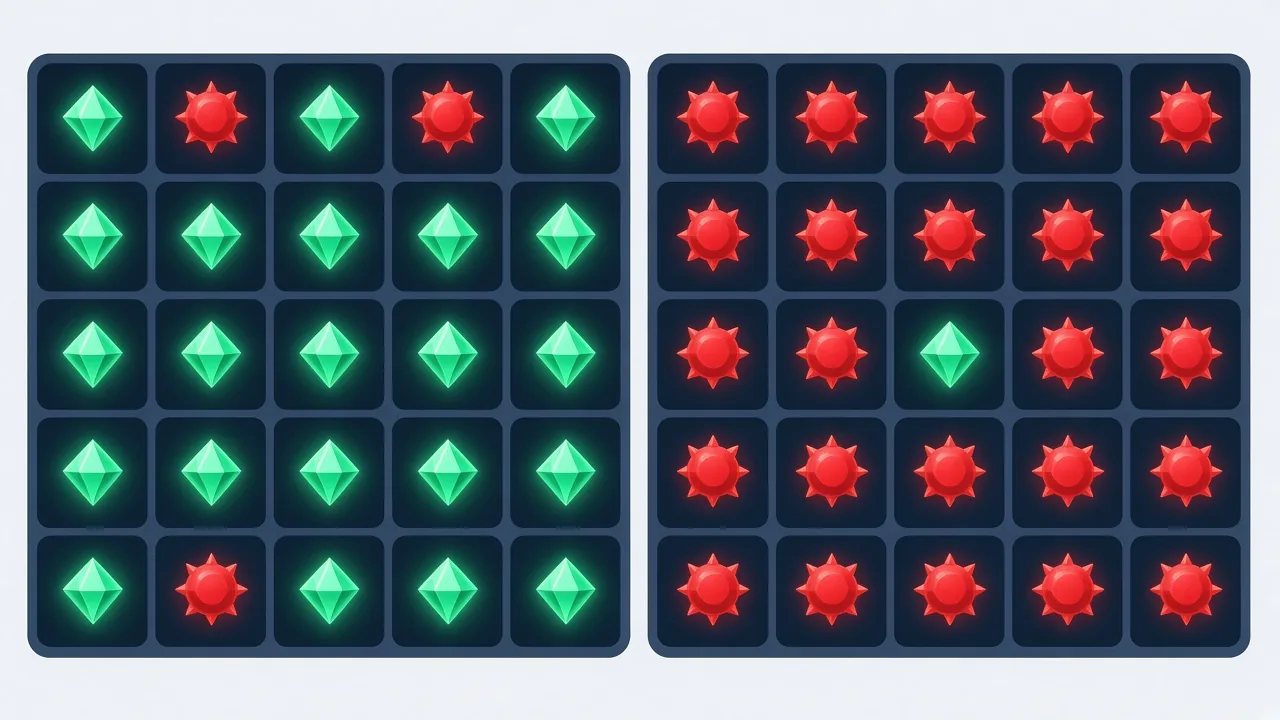
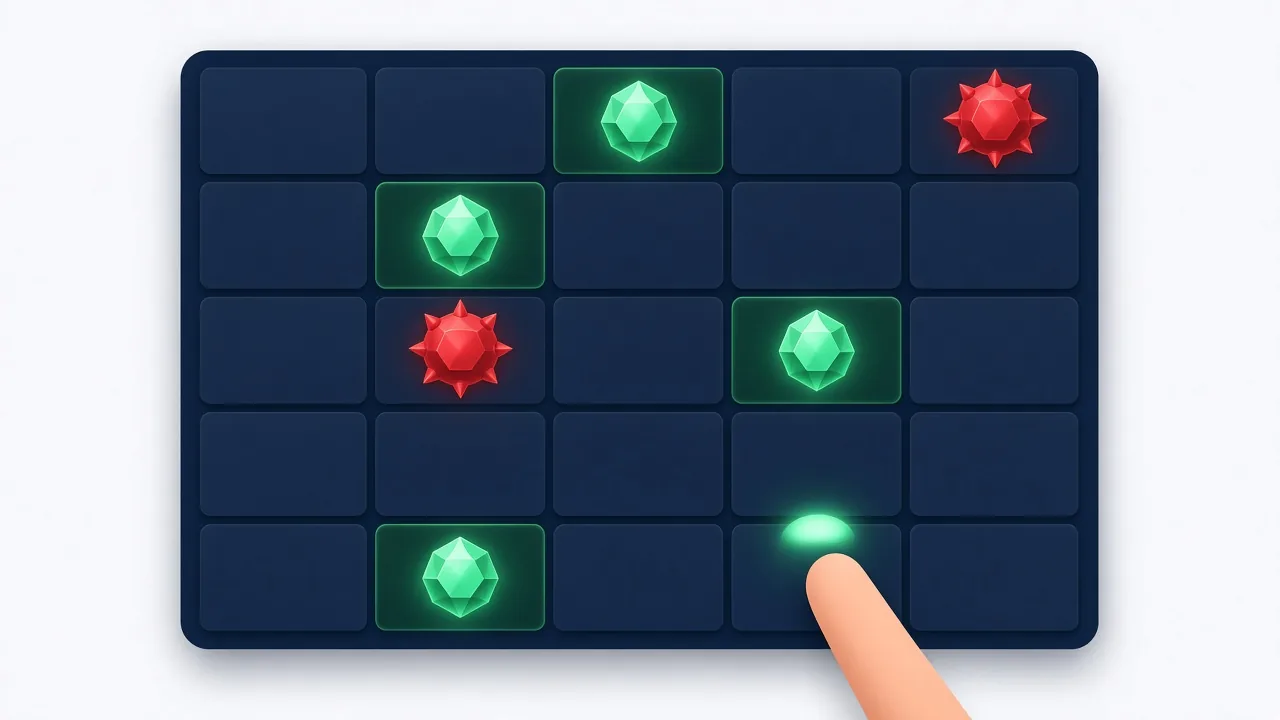
A 5x5 grid holds 25 tiles. When you set 3 mines the game picks three positions out of twenty-five and remembers them. Then it waits. Your first click hits a mine three times in twenty-five, which is twelve times in a hundred, and it makes no difference at all whether you clicked a corner, the centre or the middle of the bottom row. At that moment all twenty-five tiles are the same tile.

After one safe click the picture shifts, though not your way: 24 tiles left and the same 3 mines. The second click is riskier than the first, the third riskier than the second. That is precisely why the multiplier climbs - the game is paying for rising risk, not for a well-chosen corner.

So talk of hot tiles, zones where mines never land, or an algorithm that favours the edges describes something the game does not contain. In provably fair titles this is checkable rather than arguable: the round is sealed with a key before it starts, and the key is published after.

What the mine count genuinely changes

The only real setting in the game, and it does not work the way its name suggests.

More mines, bigger multiplier per click. Not because the game turned generous, but because the click now lands less often, and the multiplier compensates by exactly enough to leave the return where it was. InOut Games publishes a table that shows this without any algebra.

Mines on the grid First click pays Click survives Clicks available Multiplier ceiling
3x1.0788%22x2185
5x1.1880%20x50473
10x1.5860%15x3105322
24x23.754%1x23.75

The bottom row explains the format better than the other three together. At 24 mines one safe tile remains, you find it 4 times in a hundred, and it pays 23.75. Multiply four hundredths by 23.75 and you get ninety-five hundredths: the stated RTP, exactly. The game takes its five percent and nothing beyond it.

The top row is the same arrangement stretched out. Three mines, twenty-two clicks in a row, odds of finishing under a twentieth of a percent, and the same multiplier divided by the same fraction. The difference between rows is not value, it is what your evening looks like: many small wins or a few large ones.

Three habits that actually give you something

Not winning systems - governing ones. They do not touch the maths, they touch your decisions.

Name the exit before the round

Decide up front: I cash out on the third tile. Not "I will see how it goes" - the third. On 3 mines the third tile pays 1.45 and you reach it 66.96 times in a hundred. The habit works not because it is profitable but because it removes the decision from the moment you are already carried away.

One bet, one percent of the bankroll

Bet a hundredth of the roll and ten losses in a row cost a tenth of the money, and the session continues. Bet a tenth and the same streak ends everything. The mine count does not shorten those streaks: on 10 mines a first-click loss arrives in forty cases out of a hundred, and three in a row is an ordinary evening.

Demo before money

The shape of a ten-mine round takes about twenty rounds to stop surprising you. Turbo Games and BGaming both open demos on their own sites, on play credits and without an account. This is not beginner advice: it is how you avoid paying to learn what a distribution looks like.

What doubling after a loss really costs

The most heavily marketed mines system and the most expensive one. It takes a minute to price.

The pitch is persuasive: lose, double, and the first win returns everything. The problem is how fast the stake climbs. One loss doubles it, two quadruple it, eight losses in a row multiply it two hundred and fifty six times. Starting at a hundred, the ninth bet of the run is twenty five thousand six hundred.

Now the probability. Playing 10 mines and cashing out on the second tile, you lose the round roughly sixty five times in a hundred. Eight such losses back to back turn up in around three cases out of a hundred. That is not a freak event, that is a normal evening.

The outcome never varies: the system converts many small wins and one enormous loss into precisely the same return as flat betting, only with a far sharper ending. No sequence of stakes can shift the return, and that follows directly from each round being independent of the last.

Where strategy runs into the game itself

Some of the decisions are made before your first click, when you pick a version.

The sixteen mines games differ in more than artwork. Minesweeper by BGaming replaces the grid with a path and offers no mine count at all: you set the length of the walk, 3 to 15 steps, and the width of each row, 2 to 6 squares. 1Tap Mines has no settings whatsoever - a 5x5 grid, exactly 3 mines, one tap per round. And Turbo Mines hands you a 9x9 board of 81 tiles, where the ladder runs further than anywhere else here.

The practical choice follows. Want a long ladder and a large ceiling: take a big grid. Want frequency and short rounds: take 3 mines on the classic grid. Want the best return with everything else equal: read the stated RTP and take the higher one, because it is the only number in the set that moves the result by itself.

Full odds and multiplier table

Frequently asked questions about mines strategy

Which mines strategy pays the most

None of them moves the return: that is set by RTP and does not care how you click. What moves is the distribution. Careful play on 3 mines with an exit on the third tile gives frequent small wins and rare big losses. Ten mines pushed to the tenth tile gives the reverse. The averages land in the same place.

Do the odds improve after a losing streak

No. Each round builds its layout from scratch and knows nothing about the ones before it. The feeling that a win is due is the gambler fallacy, and in a fixed-probability game it is the most expensive feeling there is: doubling systems are built on it.

Does opening tiles in a pattern help

Corners, crosses, diagonals, snakes - all identical in outcome. Mine positions are locked before your first click and do not depend on the order you reveal things in. A pattern only changes speed: a route chosen in advance stops you renegotiating halfway through.

How many mines should a beginner set

Three. At 3 mines the click lands 88 times in a hundred, so a round survives long enough to show you how the ladder behaves before it ends. At 10 mines the round dies on the first or second click in forty cases out of a hundred, and it teaches you nothing.

What is provably fair and why should a player care

It is a way to prove the layout did not change after your click. The game locks the outcome with a cryptographic seed before the round and reveals the seed afterwards, so anyone can verify it. The practical consequence is blunt: any service promising to predict a mines layout is promising something impossible.

Try it on a demo and in play

Last updated -