

Turbo Games · classic grid · provably fair
Mines by Turbo Games: the game the format started with
May 2021, a 5x5 grid, diamonds, bombs and a cash-out button - no ladders above the grid, no Egyptian skins, no four sizes; the studio would invent all of that later. What it does have is a verifiable layout, an autoplay that will not let you change your mind, and a demo that opens right on this page without an account.
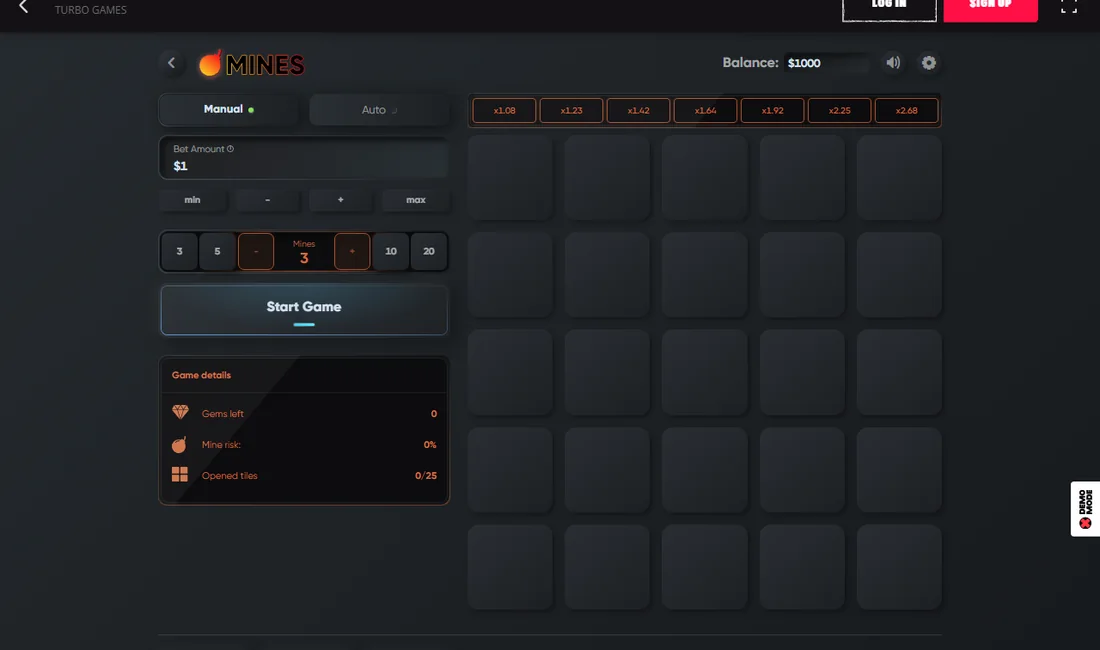
What a round looks like and what is awkward about it
On the left a panel where everything is set: stake, mine count and a switch between manual mode and autoplay. On the right the grid. No multiplier ladders above the grid like at InOut Games: the current multiplier shows in the panel, and you follow it by taking your eyes off the tiles.
That is probably the main complaint about the early version next to the later ones. The game asks you to watch two places at once, and at the moment when you decide whether to cash out or open another tile, your gaze leaves the grid. The studio fixed this later in 1Tap Mines, where all the information sits next to the grid - but there is no mid-round decision there either.
In return the mechanic is bare, and that is a plus for a first look: a grid, a mine count, a click. Stated RTP 95, ceiling 456660x - both numbers honestly sit in the game card on the studio site.
Multipliers by mine count at RTP 95
The studio does not publish a table, so the rows are computed by the format's formula with the last digit rounded - and checked against the demo: at three mines the game shows 1.08x, 1.23x, 1.42x, 1.64x, 1.92x, 2.25x, 2.68x for the first seven tiles, and all seven matched. The mine range is taken in full, 1 to 24; cells above the 456660x ceiling are marked as such.
| Mines | Safe tiles | 1st click odds | x1 | x3 | x5 | x10 | Whole field |
|---|---|---|---|---|---|---|---|
| 1 | 24 | 96.0% | x0.99 | x1.08 | x1.19 | x1.58 | x23.75 |
| 2 | 23 | 92.0% | x1.03 | x1.23 | x1.50 | x2.71 | x285.0 |
| 3 | 22 | 88.0% | x1.08 | x1.42 | x1.92 | x4.80 | x2185 |
| 4 | 21 | 84.0% | x1.13 | x1.64 | x2.48 | x8.80 | x12018 |
| 5 | 20 | 80.0% | x1.19 | x1.92 | x3.26 | x16.81 | x50474 |
| 6 | 19 | 76.0% | x1.25 | x2.25 | x4.34 | x33.62 | x168245 |
| 7 | 18 | 72.0% | x1.32 | x2.68 | x5.89 | x70.97 | cap x456660 |
| 8 | 17 | 68.0% | x1.40 | x3.21 | x8.16 | x159.7 | cap x456660 |
| 9 | 16 | 64.0% | x1.48 | x3.90 | x11.56 | x387.8 | cap x456660 |
| 10 | 15 | 60.0% | x1.58 | x4.80 | x16.81 | x1034 | cap x456660 |
| 11 | 14 | 56.0% | x1.70 | x6.00 | x25.21 | x3102 | cap x456660 |
| 12 | 13 | 52.0% | x1.83 | x7.64 | x39.22 | x10858 | cap x456660 |
| 13 | 12 | 48.0% | x1.98 | x9.93 | x63.73 | x47050 | cap x456660 |
| 14 | 11 | 44.0% | x2.16 | x13.24 | x109.3 | x282302 | cap x456660 |
| 15 | 10 | 40.0% | x2.37 | x18.21 | x200.3 | cap x456660 | cap x456660 |
| 16 | 9 | 36.0% | x2.64 | x26.01 | x400.6 | not that many tiles | cap x456660 |
| 17 | 8 | 32.0% | x2.97 | x39.02 | x901.3 | not that many tiles | cap x456660 |
| 18 | 7 | 28.0% | x3.39 | x62.43 | x2404 | not that many tiles | cap x456660 |
| 19 | 6 | 24.0% | x3.96 | x109.3 | x8412 | not that many tiles | x168245 |
| 20 | 5 | 20.0% | x4.75 | x218.5 | x50474 | not that many tiles | x50474 |
| 21 | 4 | 16.0% | x5.94 | x546.3 | not that many tiles | not that many tiles | x12018 |
| 22 | 3 | 12.0% | x7.92 | x2185 | not that many tiles | not that many tiles | x2185 |
| 23 | 2 | 8.00% | x11.88 | not that many tiles | not that many tiles | not that many tiles | x285.0 |
| 24 | 1 | 4.00% | x23.75 | not that many tiles | not that many tiles | not that many tiles | x23.75 |
Look at the 7-mine row: the whole field at seven mines is worth slightly more than the ceiling by the formula, and that is exactly where the game hits 456660x. Rows below it are not cut by the ceiling, but the chance of going all the way there is fractions of a thousandth of a percent, and there is little practical sense in them.
The working rows are 3 to 10 mines: the third click at three mines 1.42x, the fifth 1.92x, while at ten mines the same five tiles are already worth 16.81x. An exit point named before the round is the only system that works here, and the autoplay below is precisely about it.
Demo without an account: the same rules, a play balance
Loads from the Turbo Games server on click. Set 3 mines, name your exit tile and run ten rounds.
A verifiable layout and what it means in practice
The words provably fair in the game description are not decoration. Before the round the game takes a random value, derives the mine layout from it and shows you not the layout but its fingerprint. The fingerprint cannot be opened in advance, and the layout cannot be swapped after your click either: the fingerprint would stop matching. After the round the original value is revealed, and anyone can recompute it.
The everyday consequence: the mines are in place before your first click, so any service promising to "scan the field", "show the safe tiles" or "predict the layout" is promising the impossible. Technically impossible, not merely unlikely.
The second consequence is softer but more useful. Since the layout is fixed in advance, the order you open tiles in affects nothing. Corners, cross, diagonal - ways to decide faster, not to win more often. And autoplay is a way not to decide at all: you set a group of tiles and a number of rounds, and the game repeats your group by itself, without letting you change your mind on the fourth tile.
Mines by Turbo Games against its neighbours on return
The three closest versions by RTP and the shared scenario: three mines, five tiles open.
| Game | RTP | House keeps | x5 at 3 mines | Mines | Ceiling |
|---|---|---|---|---|---|
| Mines by Turbo Games | 95 | 5% | x1.92 | not published | x456660 |
| Turbo Mines | 95 | 5% | x1.92 | not published | x805001 |
| Book of Mines | 95 | 5% | x1.92 | not published | x805001 |
| Mines by InOut Games | 95 | 5% | x1.91 | 3-24 | 20000 USD |
Against Mines by InOut at the same 95, Turbo Games has two arguments: an open demo and a layout key on screen. Against its own later versions - Turbo Mines and Book of Mines - it has one, simplicity: four grids and an 805001x ceiling there, one grid and 456660x here. If you need a big ceiling or a return above the middle, this version is not yours: 95 is the middle of the set, not its top.
The same round, on a real balance
Mines by Turbo Games on the platform: stake, mine count and the cash-out button in the same places as in the demo.
Who this version suits, and who should pass
It suits anyone who wants the bare mechanic without add-ons, and anyone curious where the format began - for free, in the demo above. Pass if you want a spectacular round or a multiplier ladder in front of your eyes: for the first go to Mummy Mines, for the second to Hot Mines.
When did Mines by Turbo Games come out
In May 2021. It is the earliest game of the format among those on the platform, and the studio's whole line grew out of it: Turbo Mines, 1Tap Mines and Book of Mines came later.
What is the multiplier ceiling in this game
The studio states 456660x. That is less than the 805001x of the later Turbo Mines and Book of Mines, and the reason is grid size: the early version has one grid, the later ones have four, up to 9x9.
What is provably fair in Mines
A way to prove the layout was not changed after your click. The game locks the result with a cryptographic key before the round and reveals the key after - you can verify it. The practical consequence: no layout predictor can work, because there is nothing to predict.
How does autoplay work
You set a group of tiles and a number of rounds, and the game repeats your group by itself. It is useful not for winning: autoplay does not let you change your mind mid-round, and that is exactly what most often wrecks a pre-chosen exit point.
Does Turbo Games publish a payout table
No, only the RTP and the ceiling. The table on this page is computed by the general formula of the format at RTP 95 and checked against the ladder the game shows in its demo: the first seven multipliers at three mines matched digit for digit. Cells above 456660x are marked as the ceiling.