

Turbo Games · Books series · four grids
Book of Mines: Turbo Mines in Egyptian dress
Released in April 2024 and matching Turbo Mines down to the digit: the same four grids from 3x3 to 9x9, the same 805001x ceiling, the same RTP 95. The difference is entirely in the artwork - golden tiles, a priestess on the left, the word "curse" instead of mine - and that is a case where artwork is worth discussing on its own: it does not touch the mathematics, but it touches how fast you read the grid. Demo below.
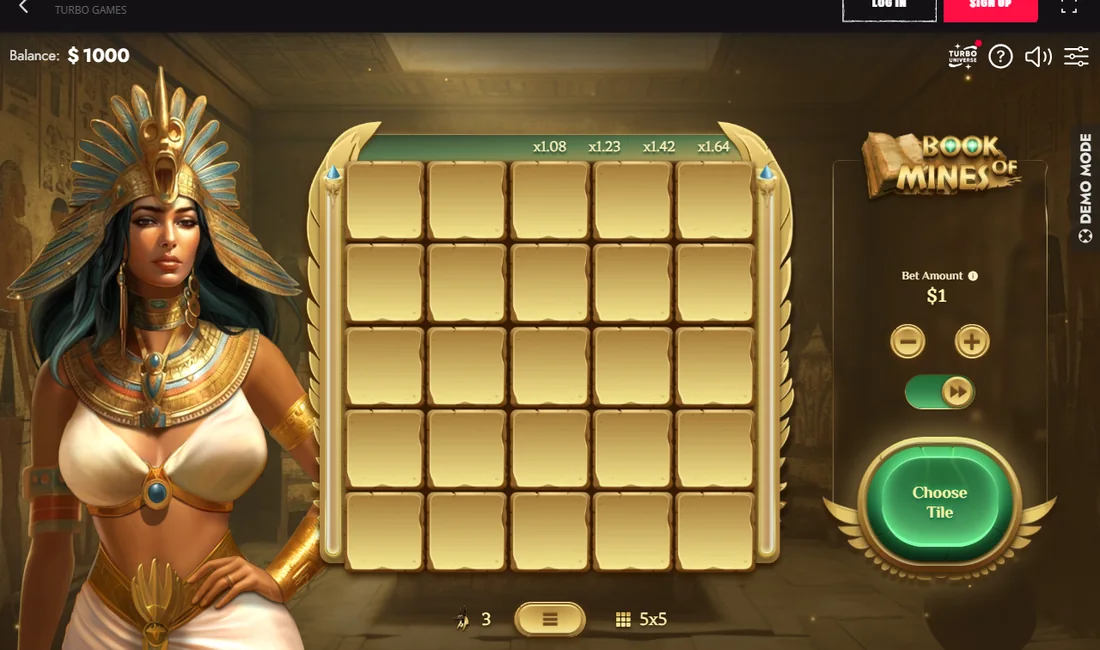
What is on screen, and what the bare version lacks
The tiles are golden and large, the multiplier ladder runs above the grid, the grid size switches at the bottom. The button is called not "open" but "pick a tile", and that describes what happens more precisely: there is nothing to open, the layout is ready before your first tap.
The character on the left is the one thing Turbo Mines does not have. The priestess has nothing to do with the mechanic and no effect on payouts, but she takes half the screen, and on a narrow phone that shows: the grid slides right. For phone play the bare version is handier; on a laptop it makes no difference, and then choose by the picture.
The word "curse" instead of "mine" is not a trifle either. A lost round here looks like a story rather than a mistake, and the next one is psychologically easier to start. Knowing the trick is more useful than avoiding games that use it.
Multipliers on the 5x5 grid at RTP 95
The mathematics is shared with Turbo Mines, so the table is the same: the format's formula, last digit rounded, checked against the studio's demo - the first seven multipliers at three mines matched. Above 805001x is the ceiling.
| Mines | Safe tiles | 1st click odds | x1 | x3 | x5 | x10 | Whole field |
|---|---|---|---|---|---|---|---|
| 1 | 24 | 96.0% | x0.99 | x1.08 | x1.19 | x1.58 | x23.75 |
| 2 | 23 | 92.0% | x1.03 | x1.23 | x1.50 | x2.71 | x285.0 |
| 3 | 22 | 88.0% | x1.08 | x1.42 | x1.92 | x4.80 | x2185 |
| 4 | 21 | 84.0% | x1.13 | x1.64 | x2.48 | x8.80 | x12018 |
| 5 | 20 | 80.0% | x1.19 | x1.92 | x3.26 | x16.81 | x50474 |
| 6 | 19 | 76.0% | x1.25 | x2.25 | x4.34 | x33.62 | x168245 |
| 7 | 18 | 72.0% | x1.32 | x2.68 | x5.89 | x70.97 | x456665 |
| 8 | 17 | 68.0% | x1.40 | x3.21 | x8.16 | x159.7 | cap x805001 |
| 9 | 16 | 64.0% | x1.48 | x3.90 | x11.56 | x387.8 | cap x805001 |
| 10 | 15 | 60.0% | x1.58 | x4.80 | x16.81 | x1034 | cap x805001 |
| 11 | 14 | 56.0% | x1.70 | x6.00 | x25.21 | x3102 | cap x805001 |
| 12 | 13 | 52.0% | x1.83 | x7.64 | x39.22 | x10858 | cap x805001 |
| 13 | 12 | 48.0% | x1.98 | x9.93 | x63.73 | x47050 | cap x805001 |
| 14 | 11 | 44.0% | x2.16 | x13.24 | x109.3 | x282302 | cap x805001 |
| 15 | 10 | 40.0% | x2.37 | x18.21 | x200.3 | cap x805001 | cap x805001 |
| 16 | 9 | 36.0% | x2.64 | x26.01 | x400.6 | not that many tiles | cap x805001 |
| 17 | 8 | 32.0% | x2.97 | x39.02 | x901.3 | not that many tiles | cap x805001 |
| 18 | 7 | 28.0% | x3.39 | x62.43 | x2404 | not that many tiles | x456665 |
| 19 | 6 | 24.0% | x3.96 | x109.3 | x8412 | not that many tiles | x168245 |
| 20 | 5 | 20.0% | x4.75 | x218.5 | x50474 | not that many tiles | x50474 |
| 21 | 4 | 16.0% | x5.94 | x546.3 | not that many tiles | not that many tiles | x12018 |
| 22 | 3 | 12.0% | x7.92 | x2185 | not that many tiles | not that many tiles | x2185 |
| 23 | 2 | 8.00% | x11.88 | not that many tiles | not that many tiles | not that many tiles | x285.0 |
| 24 | 1 | 4.00% | x23.75 | not that many tiles | not that many tiles | not that many tiles | x23.75 |
Since the mathematics is shared, the tables apply to both games without recomputation: 3 mines on a 5x5 grid behave here exactly as in Turbo Mines - 1.08x for the first tile, 1.92x for the fifth, 4.80x for the tenth. The 3x3, 7x7 and 9x9 grids follow the same formula with a different tile count; on 9x9 the ladder runs so far that 805001x stops being a figure of speech.
Book of Mines demo without an account
Loads from the Turbo Games server on click. Compare how the grid reads with and without the priestess: switch to the Turbo Mines demo afterwards.

One set of mathematics, several pictures: how studios do it
Developing the mathematics of mines is expensive: it has to be computed, tested and certified. Putting a new picture on ready mathematics is cheap. That is why studios release several games on one engine: Turbo Games made Turbo Mines and Book of Mines, InOut Games made Mines, Lucky Mines and Hot Mines, Belatra Games made Jackpot Mines and Mummy Mines.
For the player a rule follows: when two games by one studio look different, compare the numbers first. At InOut Games different pictures hide different RTPs - 95, 96 and 97. At Turbo Games the same number stands behind Turbo Mines and Book of Mines, and the choice between them is purely aesthetic.
Book of Mines against its neighbours on return
The three closest versions by RTP and the shared scenario on the 5x5 grid: three mines, five tiles.
| Game | RTP | House keeps | x5 at 3 mines | Mines | Ceiling |
|---|---|---|---|---|---|
| Book of Mines | 95 | 5% | x1.92 | not published | x805001 |
| Mines by Turbo Games | 95 | 5% | x1.92 | not published | x456660 |
| Turbo Mines | 95 | 5% | x1.92 | not published | x805001 |
| Mines by InOut Games | 95 | 5% | x1.91 | 3-24 | 20000 USD |
If the choice is between Book of Mines and Turbo Mines, take whichever looks better to you: their numbers match completely. On a phone Turbo Mines is handier, because the character does not take half the width. If the choice is wider, the classic grid offers a higher return: Hot Mines at 97 and Mines+ at 97.5, but without the 7x7 and 9x9 grids.
The Egyptian grid is waiting on the platform
Book of Mines with four grid sizes and an 805001x ceiling on a real balance.
What people ask about Book of Mines
How does Book of Mines differ from Turbo Mines
In artwork. The grids are the same four - 3x3, 5x5, 7x7 and 9x9 - the ceiling is the same 805001x, the stated RTP the same 95. What differs is the picture, the sound and the vocabulary: a curse instead of a mine, a golden tile instead of a diamond.
What is the "Books" series in instant games
The name the studio gave its Egyptian line, by analogy with the book-themed slots. Book of Mines is its first game on the mines mechanic: the studio took its own grid mathematics and dressed it in artwork familiar from a completely different genre.
Which grid size should I pick in Book of Mines
Depends on what you need. 3x3 gives a round of two or three clicks, 5x5 the familiar mathematics of the format, 9x9 with its 81 tiles a long ladder, which is where the 805001x ceiling comes from. The return is the same in all four modes; only the shape of the round differs.
Is there a demo
Yes, and it opens right on this page from the Turbo Games server, no account, on play credits. All four of the studio's games in this set open the same way, and the grid settings work fully in the demo.